
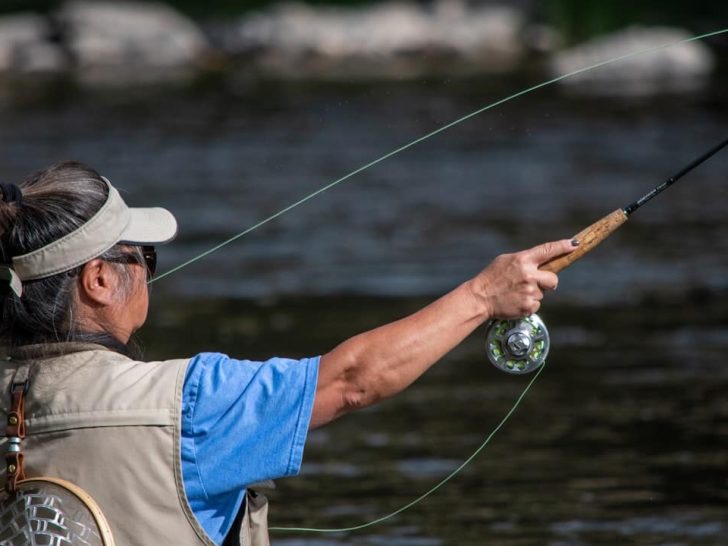
Casting is the foundation of fishing success, yet it’s one of the most overlooked skills among anglers. There’s a big difference between just lobbing your bait out there and making precise, controlled casts that put your lure exactly where the fish are holding.
Whether you’re trying to reach that far sandbar where bluefish are busting bait, drop a fly gently into a tight pocket behind mangroves, or skip a jig under a dock where bass are hiding, proper casting technique makes all the difference.
The good news? With some practice and the right fundamentals, anyone can dramatically improve their casting distance and accuracy.
In this guide, we’ll break down the essential techniques for how to case a fishing rod, for both spinning and baitcasting setups. We’ll cover the mechanics of a proper cast, how to generate more distance without sacrificing control, and techniques for placing your bait with pinpoint accuracy. We’ll also address common casting mistakes that hold anglers back and how to fix them.
Let’s walk through what it takes to master your casting game.
Table Of Contents:
- Choosing The Right Setup Before You Ever Cast
- Body Position and Grip: The Foundation of Every Cast
- How to Cast a Fishing Rod With a Simple Overhead Cast
- Casting for Distance vs. Accuracy
- How to Cast a Fishing Rod on Dry Land
- Line Management, Knots, and Preventing Tangles
- Leveling Up: From Basic Cast to Confident Angler
- Conclusion
Choosing The Right Setup Before You Ever Cast
Your cast starts way before your arm moves. It starts with your fishing gear choices. The wrong combo can turn even a good technique into a tangle fast.
Think about what you are throwing and where you are fishing. That guides everything from rod length to line type and sinker weight. Checking the product info on your gear before you buy is vital to building a balanced setup.
Rod length, action, and power that actually help you cast
A balanced rod loads like a spring when you swing and then snaps your rig forward. That loading and release is what sends your bait flying, not raw arm strength. Many family brands design their rods specifically to assist with this energy transfer.
For most bank and surf anglers, a medium or medium-fast action is the sweet spot. It bends enough to store energy, but it is still crisp so your cast does not feel mushy.
Medium-heavy power is a nice middle ground, since many rods in that range handle up to about 8 ounces. That means you can throw something like a 6-ounce sinker and a small bait without feeling like you are pushing the limits. Understanding these ratings is a core part of fishing info that beginners often overlook.
Here is a quick breakdown of rod characteristics to help you decide:
| Feature | Effect on Casting | Best Use Case |
|---|---|---|
| Fast Action | Quick tip recovery, high sensitivity | Single hook lures, precise target casting |
| Moderate Action | Deeper bend, more forgiveness | Crankbaits, live bait, treble hooks |
| Slow Action | Full parabolic bend, easy loading | Very light lures, soft baits |
Graphite vs fiberglass for casting distance
The material of your rod changes how it feels during the cast. Graphite rods tend to be lighter and more sensitive. You feel the load, and they usually snap back fast, which can add distance if your timing is on point.
Fiberglass bends deeper and forgives little timing mistakes, so newer casters often like it more at first. It is tough and takes a beating in truck beds and on rocky banks. A solid beach rod often utilizes a composite of both to get the best of both worlds.
If you want an easy casting graphite surf rod, a 12-foot Okuma Solaris Surf rated for 3 to 8 ounces gives a lot of reach without breaking the bank. For a more classic feel, the 12-foot Ugly Stik Bigwater in fiberglass has become a bit of a standard for folks who value toughness over weight. High-end surf rods may also incorporate proprietary tech similar to Daiwa technology for better performance.
Picking a reel that makes casting easier
The reel does not add power to the cast, but it absolutely can rob it if it is clunky or mismatched. You want a reel that lays line evenly, has a smooth drag, and feels balanced on the rod. While spinning reels are user-friendly, moving to baitcasting reels offers greater control once mastered.
Many surf and bank anglers lean on spinning reels like the Shimano Baitrunner 4500B or Okuma Epixor EB50. These handle strong fish and still cast smoothly when spooled correctly. If you visit a nearby store, handle the reel to ensure the weight feels right in your hand.
Whatever reel you pick, match its size to your rod length and the fish you target. An undersized reel stuffed with heavy line casts poorly and twists up fast. Always consult the product catalogue for line capacity specs before purchasing.

Line choices that help distance and control
Your line is the link between your cast and the fish, but it also affects how far and how accurately you throw. Think about water depth, bottom type, and snag risk before you spool up. Many modern fishing styles rely heavily on braided lines for their thin diameter.
Braided line from 20- to 40-pound test is a strong option for open water with a clean bottom. It is thin for its strength, which slices through the air and helps with distance. It also allows you to cast lighter lures farther than you could with thick mono.
Fishing around rocks, timber, or other snags is different. In those places, many anglers move to monofilament under 25-pound test, or even fluorocarbon, which has lower stretch and more abrasion resistance.
Basic terminal tackle for casting practice
You do not need fancy rigs to practice casts, but using the same weight range you will fish with makes your training realistic. Plain sinkers are perfect for this.
Simple bank or flat bank sinkers come off the rod smoothly and behave well in the air. If you need the weight to dig into current, pyramid sinkers or grip (Breakaway) styles can help once you move from practice to real fishing.
One more simple safety tip. Use a light glove if you are power casting with braid, since it protects your finger when you really lean into a cast. Safety is one aspect of general rod maintenance that applies to the angler as well as the gear.
Body Position and Grip: The Foundation of Every Cast
Most casting problems start before the rod even moves. Feet out of line, bad grip, or too much tension in your shoulders all show up later as short casts and wild angles.
The good news is that small fixes here pay off fast. Your cast will start feeling smoother in one session.
Foot placement for balance and power
Stand with your feet about shoulder-width apart. If you are right-handed, put your left foot slightly in front, pointing where you want to cast. Reverse it if you are left-handed.
Your weight should feel centered and relaxed, not loaded hard on one leg. During the cast, you will shift a little from your back foot to your front, but you never want to feel like you are lunging. Keep your center of gravity around waist level to maintain stability.
This stance lets your hips and core share the work with your arms. That is where the real distance comes from.

How to grip the rod and manage the line
Your hands are the control center for the whole move. For spinning gear, place the reel foot between your fingers, with two fingers in front and two behind the stem or whatever feels stable in your palm. Gripping the rod properly eliminates wobble during the swing.
Your index finger on the rod hand hooks the line and holds it gently against the rod. You do not need to crush the line. Just keep it from slipping before the cast.
Your other hand sits near the butt of the rod. This hand adds power later as you pull the butt toward your body during the forward stroke.
Rod angle and starting position
Lift the rod so it sits roughly at the 10 o’clock position behind you. The lure or sinker should hang about 18 to 24 inches below the rod tip.
This hanging weight helps the rod load when you swing forward. If the lure is right up against the tip, the rod does not bend well and the cast feels harsh.
Check for any branches or people behind you. It sounds basic, but a quick look saves a lot of awkward apologies.

How to Cast a Fishing Rod With a Simple Overhead Cast
The basic overhead cast is where most anglers start. It is the most forgiving move, and it carries over into many other styles like off-the-ground and pendulum casts later on.
Think of this as a clean, smooth swing, not a wild baseball throw. Speed comes from timing and rod load more than from raw muscle.
Step-by-step overhead cast:
- Set your stance and grip. Feet staggered, rod tip at about 10 o’clock behind you, lure hanging around two feet below the tip.
- Hook the line. Use your index finger to pull the line against the rod. Flip the bail on your spinning reel so the line can leave freely during the cast.
- Look where you want to land the cast. Pick a clear visual target like a buoy, weed line, or a spot on the bank.
- Start the motion slowly. Begin swinging the rod backward just a bit to feel the weight, then drive it forward in a smooth arc toward your target.
- Shift your weight. As you swing forward, move a little from your back foot to your front foot. Let your hips and shoulders follow the rod.
- Pull with your off-hand. As your rod hand pushes forward, your lower hand pulls the rod butt in toward your chest. This double action adds snap without extra strain on your shoulder.
- Release the line at about 1 o’clock. When your rod tip passes above your head on the way forward, straighten your index finger to let the line fly. Too early sends the cast high, too late drives it into the water or ground.
- Follow through. Let the rod finish around the 9 to 10 o’clock position in front of you. Do not stop it dead mid swing. A clean follow-through keeps the cast smooth and straight.
Timing the release for better distance and accuracy
Your release timing is the tiny piece that can make a 20-yard difference. Practice by watching the arc of the lure.
If it shoots almost straight up and drops short, you are letting go too early. If it smacks the water too close or drills into the ground, you are hanging on too long.
On a good cast, your lure leaves at a medium-low angle and glides in a nice parabola. Try to land it with the line almost straight and just a little slack as it touches down.
Common overhead casting mistakes to avoid
- Overpowering the cast. If your whole body is straining and the cast still falls short, slow down and focus on rod load.
- Starting with too heavy a weight. If your rod feels like it is about to snap, you are probably pushing its rating. Drop the sinker weight closer to the lower end of your rod range.
- Ignoring wind. Strong headwind needs a lower, flatter trajectory. Crosswind may require aiming a bit upwind so the line drifts back over target.
Casting for Distance vs. Accuracy
At some point, you will hit that wall where every cast seems the same distance. That is when you shift your focus from more power to better technique.
There is also a big difference between sending a bait far across a sand flat and placing a lure beside one dock post. You train those skills slightly differently. Surf fishing often demands raw distance, while fishing around docks requires precision.
Tips to add a safe distance to your cast
Distance is fun, but it should not wreck your shoulder or snap off rigs. Build it the right way and it sticks with you season after season.
- Use a long enough rod. Rods around 9 to 12 feet often give bank anglers better leverage for long casts, especially in surf condi