
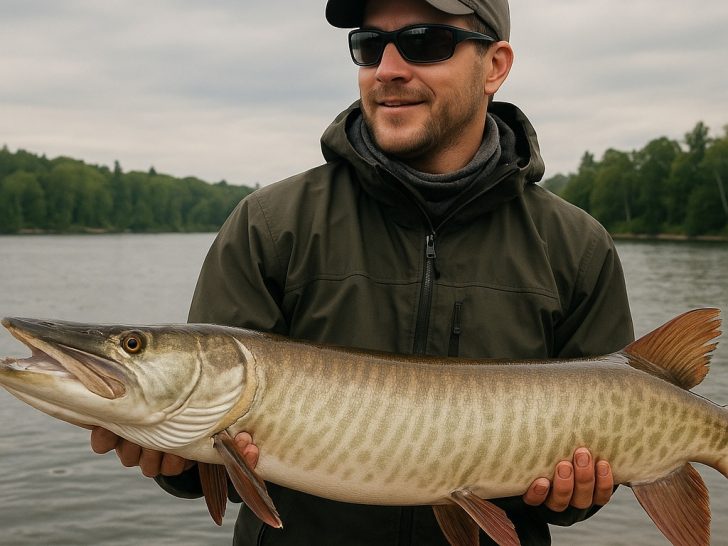
If you’ve ever dreamed of feeling the world’s largest freshwater predator scream at the end of your line, then muskie fishing is one of the ultimate angling challenges.
These toothy torpedoes — sometimes called “the fish of 10,000 casts” — are legendary for turning quiet water into a gladiator’s arena. But beneath the thrill lies strategy, technique, and a few battle-tested secrets.
Whether you’re gearing up for your first hunt or you’ve tangled with muskie before, this guide will push you past guesswork. We’ll cover the must-know muskie fishing tips, from ideal tackle and lure choices to reading structure and timing your strikes, to help you hook into more of these majestic beasts.
Get ready: your next cast might just change the game.
Table Of Contents:
- Know The Beast: The Muskie Mindset
- Gear Up Right: Don’t Bring a Knife to a Gunfight
- My Top Lures for Muskie (and When to Use Them)
- Proven Muskie Fishing Tips and Techniques
- Handling the Legend: Proper Catch and Release
- The Mental Game: Patience and Persistence
- Conclusion
Know The Beast: The Muskie Mindset
You have to think like a predator to catch one. Muskies don’t waste energy chasing small snacks all day, which is why musky anglers use such large muskie lures. We are trying to imitate a full meal for a hungry giant, something that justifies the energy expense.
A muskie’s behavior changes a lot with the seasons, as water temperature dictates almost everything they do. Knowing their mindset helps you choose where to cast and what to throw when chasing muskies.
It’s the foundation for every other tip here; don’t just blindly cast at the water, cast with a purpose to target muskie effectively.
Seasonal Shifts and Water Temperature
In the spring, as warmer waters creep into the shallow bays, muskies move in to spawn. Post-spawn, they can be sluggish but will start feeding on shallow flats and new weed growth.
As summer arrives and water temperatures rise, many large muskies will relate to the main content of the lake, holding on points, humps, and the edges of deep weed beds.
Then comes early fall, a magical time for any musky angler. As the water temperature begins to drop, muskies know winter is coming and they need to feed heavily. This is when you’ll find them actively hunting over remaining green weed beds and rocky structures.
During late fall, the bite can be legendary as fish consolidate near their wintering holes. These deep holes provide stable temperatures during the harshest weather. Finding these spots and presenting a slow-moving bait can lead to catching the biggest musky fish of your life.
Feeding Behavior and Triggers
Muskies are opportunistic but can also be incredibly selective. They often follow a lure right to the boat, a behavior that frustrates countless anglers. This is usually a sign of curiosity, not necessarily a refusal to eat. The fish wants a better look before committing to an attack.
Understanding local forage species is a huge advantage. If muskies in your lake primarily feed on suckers, a lure that mimics that profile and color can be more effective. If they are chasing fatty ciscoes in open water, large spoons or crankbaits might be the better choice.
While they share some habitat with northern pike and chain pickerel, muskies have a different temperament. They are generally less numerous and often more cautious. A sudden change in lure direction or speed is frequently what turns a follow into a strike, triggering that predatory instinct.
Gear Up Right: Don’t Bring a Knife to a Gunfight
Let’s talk about the gear muskie fishing requires. A seven-foot bass fishing rod is not going to cut it. You need equipment built to handle lures the size of a squirrel and fish that pull like a small boat.
This is about more than just landing the fish. It’s about being able to properly work the giant lures muskies crave. You need the right tools for this job, and compromising here will only lead to disappointment.
Rods and Reels for Muskie
Your rod needs to be a beast. Look for something between eight and nine and a half feet long with heavy or extra-heavy power and a fast action. This length gives you leverage for huge figure 8s at the boat, and the power lets you throw massive baits and get a solid hookset.
For the reel, a heavy-duty baitcaster is your only real option. You’ll want one with a low gear ratio, like something in the 5:1 range, especially for pulling resistant lures. This gives you the cranking power needed to pull huge, resistant lures like double-bladed in-line spinners through the water all day without wearing you out.
Some musky anglers prefer a faster reel for baits like jerkbaits or a soft plastic, but a low-speed model is a great all-around choice to start with. The key is a solid drag system and a large line capacity. Pay attention to how the reel feels in your hand, as you’ll be making hundreds of casts a day.

Line and Leader
This is not the place to go light; it’s time to beef up your setup. Spool that reel up with 80- to 100-pound braided line. We don’t recommend anything less than an 80-pound braid, as the no-stretch nature of braid helps drive those thick treble hooks home from a long distance.
A strong leader is non-negotiable. Muskies have a mouth full of razor-sharp teeth that will slice through your braid instantly. You can use a heavy fluorocarbon leader, around 100 to 130-pound test, or a quality steel leader.
Always check your leader for frays or kinks after catching fish or snagging on submerged logs. A damaged leader is a weak link waiting to break on the fish of a lifetime. Many a heartbreaking story starts with a failed leader.
Essential Tools
You must have the right tools in the boat before you even make a cast. A giant net or a cradle is essential for landing the fish safely for both you and the musky. Once in the boat, you’ll need a pair of long-nosed pliers to get the hooks out.
Sometimes, the hooks are buried deep. This is why you absolutely need a pair of hook cutters, also called bolt cutters. It’s far better to cut a hook and save the fish than to damage its mouth trying to pry it out.
Jaw spreaders can also help, but use them with care to avoid hurting the fish. A good pair of gloves will protect your hands from teeth and hooks. Having these tools organized and ready is part of being a responsible and successful muskie angler.
My Top Lures for Muskie (and When to Use Them)
Walking into pro shops to look at muskie tackle can feel overwhelming. There are so many huge, crazy-looking baits and lure styles. The truth is, you only need a few key types to get started and cover most situations you’ll face on any muskie water.
These are the lure categories that are always ready to go in my boat. A basic understanding of how and when to use them will dramatically increase your odds. They’ve produced for me time and time again across many different muskie waters.
| Lure Type | Best Used | Technique | Primary Imitation |
|---|---|---|---|
| Bucktails & In-line Spinners | Active fish, covering water, windy days | Steady retrieve, bulge under the surface | Baitfish school |
| Jerkbaits & Glide Baits | Neutral or inactive fish, clear water | Rod twitches and pauses create side-to-side action | Wounded or dying baitfish |
| Large Crankbaits | Targeting specific depths, structure fishing | Cast and retrieve, trolling | Large baitfish (sucker, cisco) |
| Topwater Lures | Low light (dawn/dusk), calm evenings, shallow water | Varies: steady retrieve, rip and pause | Distressed surface prey (duckling, rodent) |
| Large Soft Plastics | Cold water, pressured fish, versatile depth control | Slow roll, jigging, rip and fall | Anything from suckers to eels |
- Bucktails and In-line Spinners. These are the search baits of musky fishing, allowing you to cover water faster than any other lure. The flash and vibration from the big blades call fish in from a distance. I love these in early fall and anytime the fish seem active and are willing to chase.
- Jerkbaits and Glide Baits. These are more subtle presentations that require angler input to create their action. They have an erratic, side-to-side action that imitates a wounded baitfish, which can be deadly. Glide baits take practice to work correctly with your rod, but this unpredictable action can trigger strikes from muskies that ignore other baits.
- Big Crankbaits. When you need to get down into deeper water along weed lines or rock piles, a big-lipped crankbait is the ticket. You just cast it out and reel it in, allowing the lure to dive to its designated depth. The lure does all the work, wobbling along and drawing reaction strikes from fish holding deep.
- Topwater Baits. There is nothing in freshwater fishing more exciting than a muskie blowing up on a topwater lure. These are most effective in low light, like at dawn or dusk, or on cloudy days. The commotion they make on the surface is something no nearby musky can ignore as it signals an easy meal.
- Large Soft Plastics. Giant rubber baits, often called “big rubber,” have become a go-to for many serious muskie hunters. You can fish them at any depth in the water column with different retrieve speeds, from a slow crawl to a fast burn. The subtle action of a soft plastic can tempt even the most inactive fish, especially in cooler water temperatures.
Proven Muskie Fishing Tips and Techniques
Having the right gear is just part of the battle. How you use it is what really puts fish in the boat. Certain techniques are fundamental to success, and ignoring them will cost you fish and valuable water time.
I’ve learned these lessons the hard way, over years of trial and error. You can learn them right here. Put these practices to use, and you’ll notice more followers and more strikes.
The All-Important Figure 8
If you take only one thing away from this guide, let it be this: always finish your cast with a figure 8. Muskies are famous for following lures right to the boat without striking. The figure 8 is your last chance to turn that follow into a catch and is one of the most productive muskie techniques.
As your lure nears the boat, dip your rod tip deep into the water. Move it in a wide, sweeping figure 8 or oval pattern, making sure to accelerate through the turns. This sudden change in direction and speed often triggers a violent lure hit right at your feet, so be ready.
Countless large muskies have been caught this way, so make it a habit on every single cast. Don’t get lazy, even after hours without seeing a fish. That one cast where you do it properly could be the one that changes your day.

Location, Location, Location
You can’t catch a muskie where there are no muskies. Finding their ambush spots is a critical piece of the puzzle. Look for weed lines, sunken islands, points, and sharp drop-offs on your map, as these are spots where fish hold.
Pay attention to what’s going on around you when you’re on the water. Are there schools of baitfish in the area? Are birds diving nearby? These are all signs that you are in a great place to start your search.
Knowing where muskies live changes with the seasons. In summer, they might be in open water chasing suspended bait, while in late fall, they’ll be staging near wintering holes. Don’t be afraid to move if a spot isn’t producing; sometimes a change of a few hundred yards can make all the difference.
Time Your Trip
Muskies can be caught at any time of day, but they often have predictable feeding windows when muskies feed more aggressively. The low-light periods of dawn and dusk are prime times. Overcast and windy days are also excellent, as the choppy water seems to make them less cautious.
Many serious musky anglers also pay close attention to moon phases. The days around a full moon or new moon are often considered hot periods. Data from various sources suggests that moon overhead and moon underfoot times can trigger major feeding activity.
It doesn’t always work, but if you’re thinking about planning a trip, looking at the solunar calendar is another factor to consider. It might give you an edge, especially on a high-pressure day when the bite is tough. When the fish don’t feed for long, these windows are your best opportunity.

The Weather Matters More Than You Think
Changing weather is a huge trigger for muskies. A stable weather pattern can lead to slow fishing. But an approaching storm front and the associated drop in barometric pressure can send them into a feeding frenzy.
If you see a storm front rolling in, it’s time to be at your best spot. The wind is also your friend, even though it can make boat control difficult. Wind-blown points and shorelines push baitfish into concentrated areas, and the muskies won’t be far behind.
These changing water conditions are a dinner bell. Don’t head for the dock when it gets a little choppy. Instead, gear up and hit those wind-swept areas where bait is being pushed up against structure.
Handling the Legend: Proper Catch and Release
Hooking a muskie is just the beginning. Landing and releasing these giants requires a plan. It’s all about keeping both you and the fish safe for a future fight.
A stressed or poorly handled fish has a low chance of survival, and these are a precious resource. Most dedicated musky anglers practice 100% catch and release to preserve these incredible fisheries for years to come. The goal should always be to get the fish back in the water as quickly and healthy as possible.
Keep the fish in the water as much as possible inside a large net or cradle that supports its entire body weight. Once you have control of the fish, use your tools to quickly remove the hooks. Have a partner ready to help; one person controls the